
Key Takeaways
- Younger Americans are the most likely to say their debt is getting worse. Over the past 12 months, 45% of Gen Z saw their debt increase, compared with 39% of millennials, 34% of Gen X and 30% of baby boomers. Baby boomers are the only generation significantly more likely to say their debt decreased.
- The emotional burden of debt falls especially heavily on younger generations. Nearly 6 in 10 Gen Z and millennial respondents say they often or always feel stressed when thinking about debt, versus 36% of baby boomers.
- Debt is disrupting different milestones at different ages. Gen Zers (38%) and millennials (31%) say debt has prevented them from saving for or buying a home, while Gen Xers (41%) are having to cut back on retirement savings.
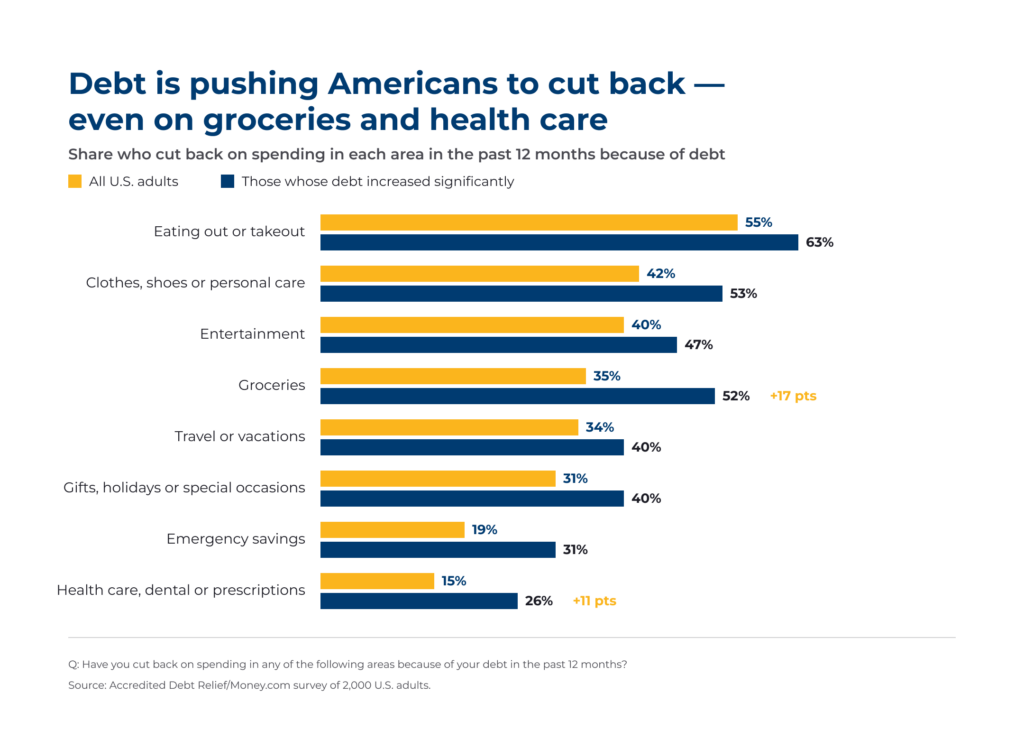
- Americans are making meaningful sacrifices to deal with debt. Overall, 55% have cut back on eating out or takeout because of debt, 42% have cut clothing or personal care spending, 35% have cut groceries and 19% have reduced emergency savings.
- Rising costs rival personal spending as a source of debt. Two-thirds of respondents say their own spending or borrowing decisions contributed to their debt, but even more cite inflation (78%) and housing costs (68%).
Debt is shaping far more than Americans’ monthly budgets. It is influencing whether people buy homes, save for the future, change careers and even start families — and those effects look very different depending on age.
To understand how debt is affecting consumers in 2026, Accredited Debt Relief and Money.com surveyed 2,000 Americans. The results reveal clear generational differences: Younger adults are more likely to say their balances are rising and debt is interfering with major milestones. Gen X faces pressure around saving for retirement and baby boomers generally report greater financial stability.
“What stands out here is that debt hits differently in different life stages” says Bobbi Rebell, chief financial education advisor at Accredited Debt Relief. “For a 20-something, that can mean delaying a first home or starting a family. For someone in their 50’s it can mean reworking a retirement plan that they previously thought was on track. But the common theme here is that it throws off someone’s expectations for where they would be at certain life stages in terms of goals and milestones in their life.”
Younger generations are falling further behind — and feeling it more acutely
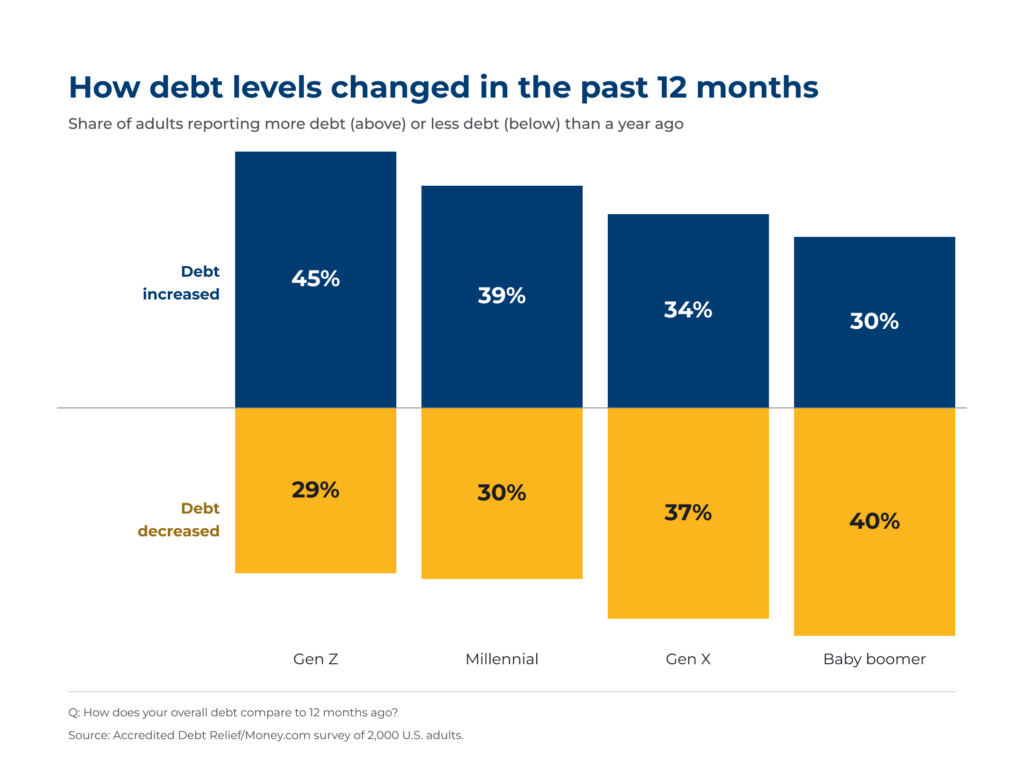
Rising costs are straining Americans across generations, but younger adults are more likely to say their debt is heading in the wrong direction. Forty-five percent of Gen Z and 39% of millennials say they owe more than they did a year ago, compared with 34% of Gen X and 30% of boomers. Boomers, meanwhile, are the only generation substantially more likely to report decreasing debt than increasing debt.
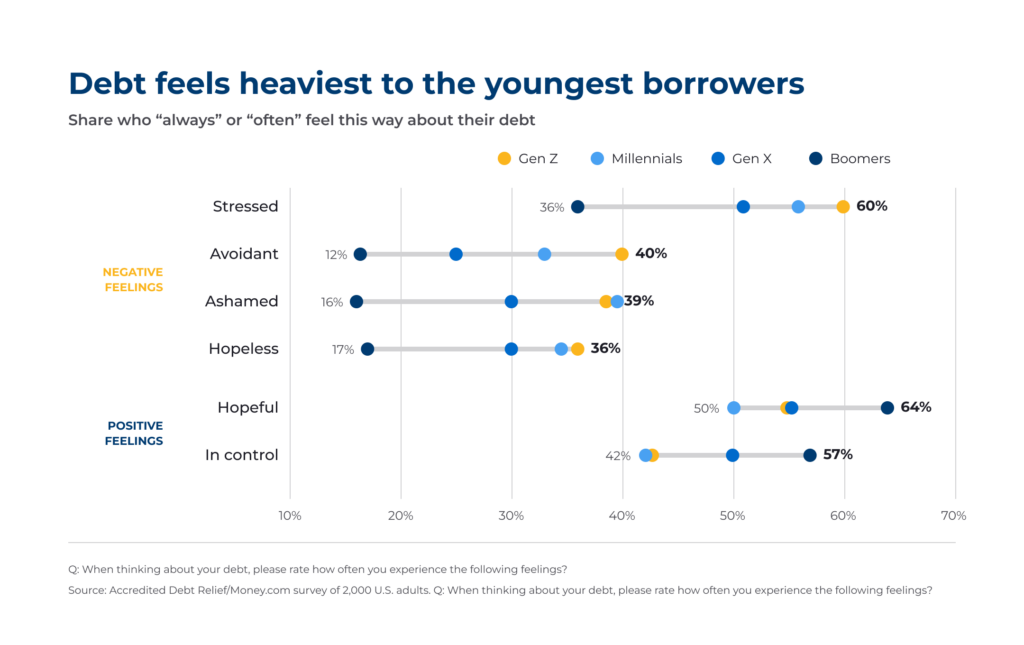
Those differences show up in how people feel about repayment, too. Fewer than 3 in 10 Gen Zers and millennials are optimistic about paying off their debt, compared with 37% of Gen Xers and nearly half of boomers. Younger respondents were also more likely to report that they frequently experienced negative feelings about debt, including feeling stressed, ashamed and hopeless.
Major affordability challenges hit everyone, but some sting particularly hard for different generations
Respondents from every generation ranked inflation as the No. 1 reason for carrying more debt, with nearly 8 in 10 borrowers saying it had at least a moderate impact on their finances. Two-thirds of all respondents also blamed personal spending decisions and the high cost of housing.
Beyond those broad pressures, some causes stood out by generation. Low wages and job losses were particularly pronounced among millennials, with 68% citing them as contributors to their debt. More than half of millennials also said the cost of raising children or providing elder care was a factor.
Gen Zers were more likely to report a lack of financial education (51%) as a root cause of their debt, compounded by recent changes in laws, taxes and government programs (55%). It’s possible this includes the recent changes to the federal student loan program, since Gen Zers reported that student loans and the high cost of education contributed to their debt.
When asked specifically about factors driving unsecured debt, the most likely causes across generations were rising everyday prices (35%), medical bills (24%) and car bills or other transportation costs (22%).
Debt is delaying and shrinking the American dream for every generation
Homeownership, career advancement, raising a family and a comfortable retirement are all central pieces of the American dream. But for many borrowers, debt is making those milestones harder to reach — and the pressure looks different at each stage of life.
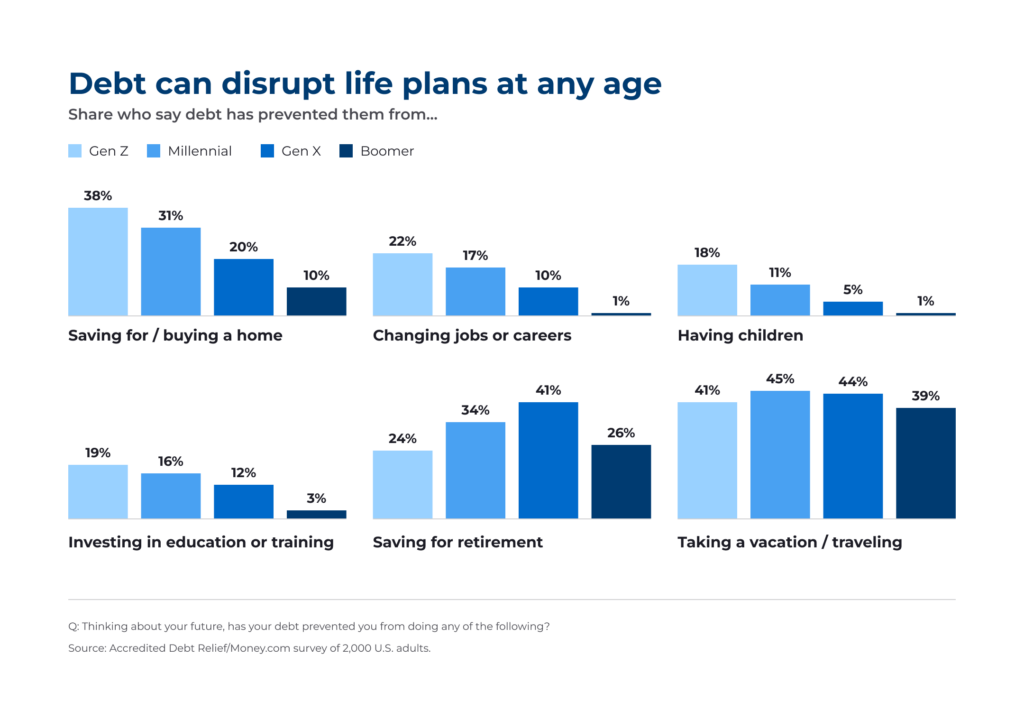
For younger adults, debt is interfering with achievements that often mark financial independence. More than a third of Gen Z and nearly a third of millennials say debt has kept them from saving for or buying a home. Gen Z also stands out for saying debt has delayed career moves and plans to start a family.
For Gen X, the pressure shifts toward the future: 41% say debt has prevented them from saving for retirement, the highest share of any generation. Boomers are much less likely to report that debt has blocked any major milestones, although more than 1 in 5 say it has forced them to cut spending in retirement.
Debt habits run in families, but younger adults want to change them
Debt is not just an individual financial issue. For many Americans, attitudes about borrowing are shaped by what they saw growing up.
That influence is especially pronounced among younger adults. Roughly 6 in 10 Gen Zers and millennials say their parents’ money habits affected the way they think about debt. At the same time, about two-thirds of both generations say they want to develop different debt habits than their parents.
Younger adults also appear more willing to talk openly about debt. Nearly twice as many Gen Zers say they discuss debt with family as boomers (34% vs. 19%), and they are nearly three times as likely to discuss it with friends (26% vs. 9%).
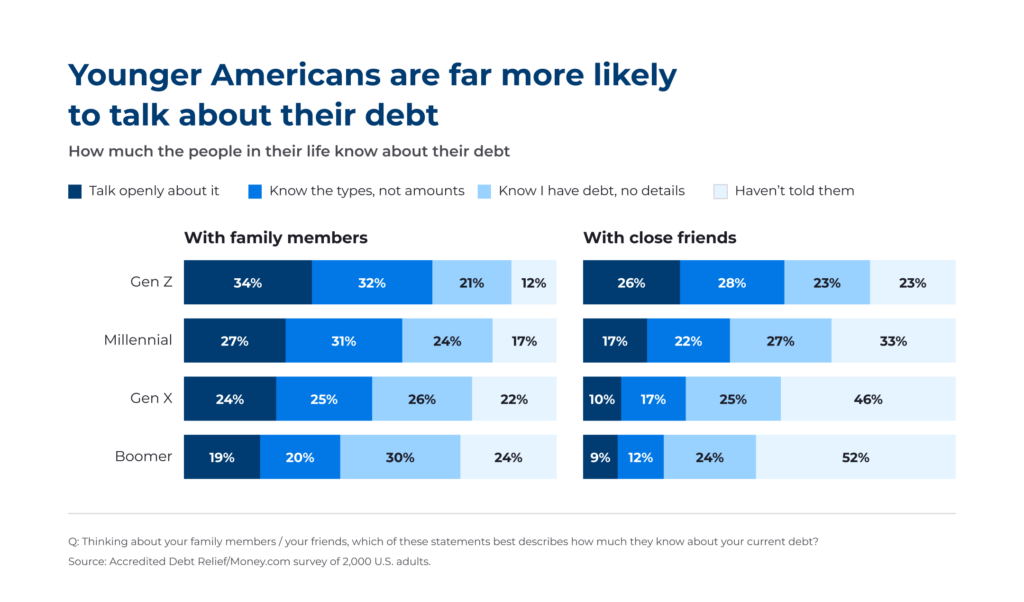
Still, greater openness does not always mean complete transparency. Only half of respondents overall say they have always been honest with family or close friends about how much debt they owe.
Family obligations can complicate debt repayment too. Nearly 1 in 5 Gen Zers say they took on new debt in the past year to help a family member, while 21% delayed paying down their own debt for the same reason, more than twice the share of boomers.
Generations are using different strategies to manage their debt
How people manage debt also changes with age. Older borrowers are more likely to attack balances directly: Half of boomers and 41% of Gen Xers say they paid more than the minimum during the past year. Bringing in additional cash for debt payoff was more common among younger borrowers. Roughly a quarter of Gen Zers and millennials took on extra work or a side gig, while Gen Zers were the most likely to say they had borrowed from family, dipped into savings or delayed payments. Some of those strategies can create new risks, especially if they leave borrowers without an emergency cushion or damage their credit.
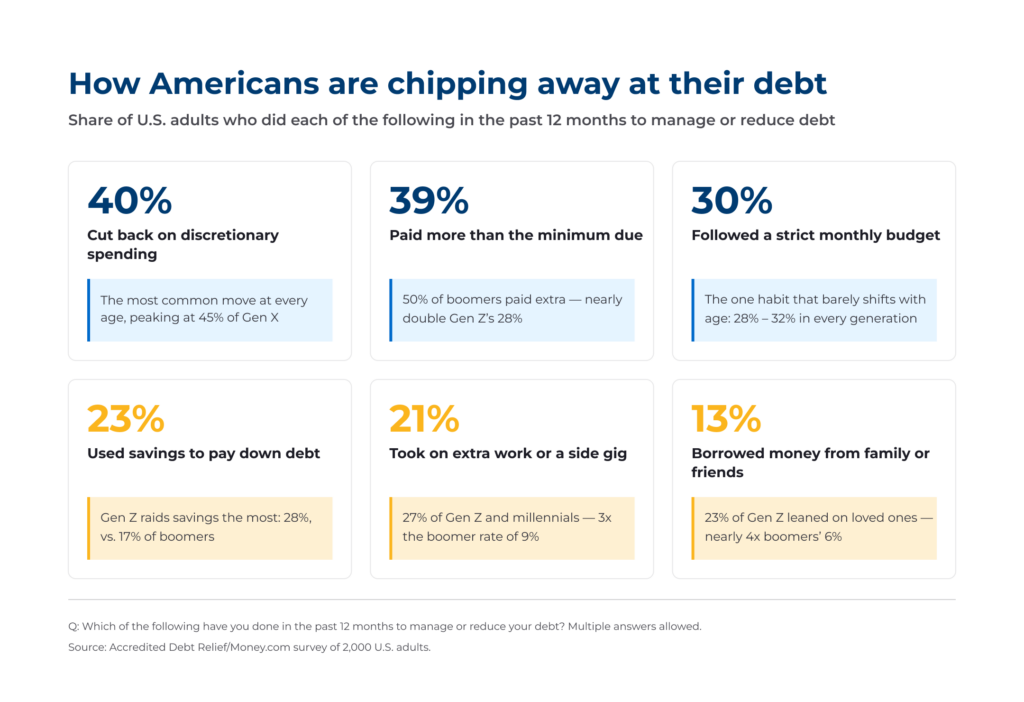
“Paying down debt aggressively makes sense. But it should not come at the cost of having a financial safety net,” Rebell says. “Draining your emergency savings to pay off a balance can create a cycle of debt when the unexpected happens again. The goal is to pay the debt off in a way that is sustainable and creates guardrails for the borrower from future financial trauma. Avoiding the anxiety of financial vulnerability and future missed payments is the goal.”
From groceries to savings, debt is forcing Americans to make everyday sacrifices
Debt can reshape where households spend and where they cut back. By and large, these cutbacks were similar across age groups. Instead, the driver for these spending decisions was correlated with how much a respondent’s debt had changed over the past year.
Those whose debt increased the most tended to make the most drastic cuts, but not in areas where you might expect. While these borrowers still cut back on discretionary spending — i.e., “wants” — like everyone else, they also tended to focus more heavily on reducing spending on “needs” too.
Respondents with quickly-increasing debt loads were more likely than any other group to cut back spending on groceries, utilities, home and car repairs, health care and even emergency savings.
“We talk a lot about wants vs. needs. Cutting back on food delivery or new clothing is a smart strategy that can make a lot of sense. Those fall into the wants category,” Rebell says. “But when someone needs to cut back on essentials like healthcare or groceries, or chooses to delay repairing a car they need to get to work to earn money, those are big warning signs. It means that there isn’t any room left to maneuver their budget on their own. This is the time when a debt relief conversation can make sense to prevent an even more urgent financial situation that will have more serious and painful consequences.”
The findings suggest that those with the fastest-growing debt loads have already cut as much as they can from discretionary spending and are now being forced to scale back on basic needs like food, shelter and health. Those tradeoffs can spiral into even more expensive problems down the line.
Methodology
This survey was conducted by aytm on behalf of Accredited Debt Relief and Money.com in July 2026, among a nationally representative sample of 2,000 U.S. adults who reported having some type of debt in the past year. The following birth years were used to determine generations: 1946 to 1964 for baby boomers, 1965 to 1980 for Generation X, 1981to 1996 for millennials and 1997 to 2012 for Gen Z.
The information on this site is provided as a general resource and does not constitute legal, tax, or financial advice.