
Most people would go into debt for an emergency. But what about for a party? Accredited Debt Relief’s new survey shows that many people are willing to go into debt simply to be present for an event.
Thirty-three percent of respondents would go further into debt, usually on a credit card, rather than miss an occasion, according to the survey of 2,000 U.S. adults carrying debt. Going into debt is only half the story: 85% also hide the full extent of what they owe from at least one person in their life.
The two go hand in hand. The pressure to keep up drives the spending, the spending deepens the debt, and hiding it keeps anyone from stepping in to help. But borrowing to keep up isn’t really about bad money habits — it’s about how much people will spend to avoid being left out.
Key Takeaways
- 1 in 3 Americans (33%) say they would go further into debt rather than miss a major event or gathering — usually on credit cards.
- 85% hide the full extent of their debt from at least one person in their life, and 54% hide it specifically from friends.
- 70% of cardholders say the bulk of their balance came from everyday costs like groceries, gas and utilities — evidence this isn’t a spending problem.
The Fear of Missing Out Is Pushing People Deeper Into Debt
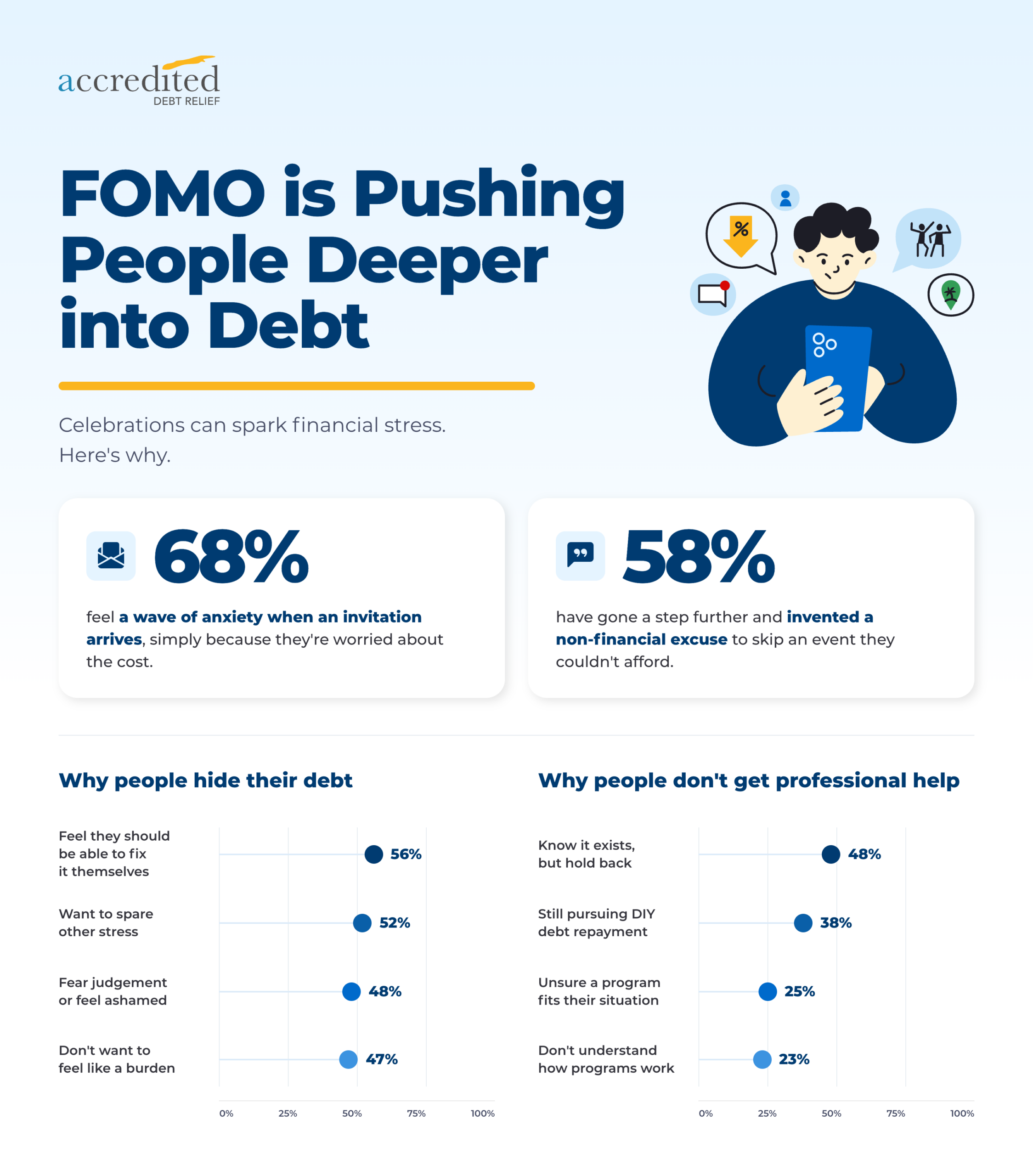
For many, the strain starts before they even RSVP. 68% of respondents said they feel a wave of anxiety when an invitation arrives, simply because they’re worried about the cost. More than half (58%) have gone a step further and invented a non-financial excuse to skip an event they couldn’t afford.
Avoidance is only one response; others spend anyway. Thirty-three percent said they would take on more debt rather than miss an event, even when the money isn’t there. The choice can look reckless, but it reflects how much people value belonging. Pew Research Center found in January 2025 that about one in six U.S. adults feel lonely or isolated most of the time, and roughly four in ten at least sometimes, with adults under 50 hit hardest. Together, the numbers suggest people are borrowing less to splurge than to stay connected.
Hiding the Bill
But borrowing to be present at loved ones’ big life events is only part of the story. Eighty-five percent of respondents said they hide the full extent of what they owe from at least one person in their life. Friends are the group most likely to be kept in the dark, at 54%, followed by children and parents, each at 37%.
Most aren’t hiding it to deceive anyone. The top reason was self-reliance: 56% said they feel they should be able to fix it themselves. Another 52% wanted to spare others the stress, 48% pointed to shame or fear of judgment, and 47% didn’t want to feel like a burden. That instinct to handle it alone is also what keeps many from getting help.
This Isn’t a Spending Problem
The survey’s other findings cut against the idea that this debt is just overspending. Among respondents with credit card debt, 70% said most of their balance came from everyday costs — groceries, gas, utilities — not splurges. Credit cards were the most common form of debt (69%), followed by medical bills (43%) and overdue utility bills (39%).
When the basics already eat up the paycheck, there’s nothing left for a birthday dinner or a wedding gift, so it goes on a credit card. For many, that’s how the balance builds.
Finances Shape Mental Health
Going into debt to attend special occasions has a greater cost than just credit card payments. 67% of respondents said their debt leaves them stressed, anxious or overwhelmed, and 47% said it has hurt their mental health. The money pressure is real, too: 49% live paycheck to paycheck because of their debt payments, and 37% said they couldn’t cover a $1,000 emergency without turning to credit.
Keeping it secret makes it worse. Debt is stressful enough on its own, and carrying it with no one to talk to only adds to the weight. If debt is weighing on your mental health, you don’t have to face it by yourself — talking to someone you trust, or a professional, can help.

FOMO is Pushing People Deeper into Debt
Celebrations can spark financial stress. Here’s why.


Why People Wait to Get Help
Knowing help exists isn’t the problem. 48% said they’ve held back from getting help anyway — 25% aren’t sure a program fits their situation, and 23% don’t understand how one works. Another 38% are still trying to pay the debt off on their own.
The same instinct to handle it privately is often what keeps people stuck. For many, the first real step is the plainest one: telling someone — a friend, family member or a professional — the full amount they owe.
If you’re carrying debt you haven’t told anyone about, a no-pressure conversation with a real person is a low-stakes place to start — no obligation, and it won’t affect your credit to ask.
Frequently Asked Questions About Debt in America
How many Americans hide their debt, and from whom?
Eighty-five percent hide the full extent of their debt from at least one person in their life. Friends are the most common blind spot at 54%, followed by children (37%) and parents (37%).
Why do people hide their debt?
The top reason isn’t secrecy — it’s self-reliance. Fifty-six percent feel they should be able to fix it themselves, 52% want to shield others from stress, 48% feel shame or fear of judgment, and 47% refuse to feel like a burden.
How does debt affect mental health?
Sixty-seven percent of respondents feel stressed, anxious or overwhelmed because of their debt, and 47% say it has had a direct negative effect on their mental health. Only 12% report no impact on their daily life.
What would help people address their debt sooner?
Understanding, not awareness. Forty-eight percent know debt relief programs exist but hold back — 25% aren’t sure a program applies to them and 23% don’t understand how one works — while 38% are still trying to pay it off on their own. Getting started can be simpler than people expect: Accredited Debt Relief offers a free, no-obligation savings estimate that takes just a few minutes, and requesting one won’t affect your credit.
Source and Citation
All primary figures are from the Accredited Debt Relief 2026 Debt Impact Survey, conducted by Drive Research (n = 2,000 U.S. adults with unsecured debt; ±2% margin of error; published June 2026).
Supporting context: Pew Research Center, “Men, Women and Social Connections” (Jan. 16, 2025; American Trends Panel, n = 6,204 U.S. adults, fielded Sept. 3–15, 2024). https://www.pewresearch.org/social-trends/2025/01/16/men-women-and-social-connections/
The information on this site is provided as a general resource and does not constitute legal, tax, or financial advice.