
According to the Federal Reserve Bank of New York, total household debt increased to $18.8 trillion in Q1 of 2026. What’s more, 4.8% of outstanding household debt was in some stage of delinquency. If you’re one of the many indebted people trying to avoid missing payments, you might be searching for free debt help.
More options exist than most people realize. Nonprofits and government agencies provide guidance, resources, and support to people dealing with debt at no cost.
This post walks through each category of free debt help options — what they are and how they work — along with the signs that free help may not be enough and other professional services worth knowing about.
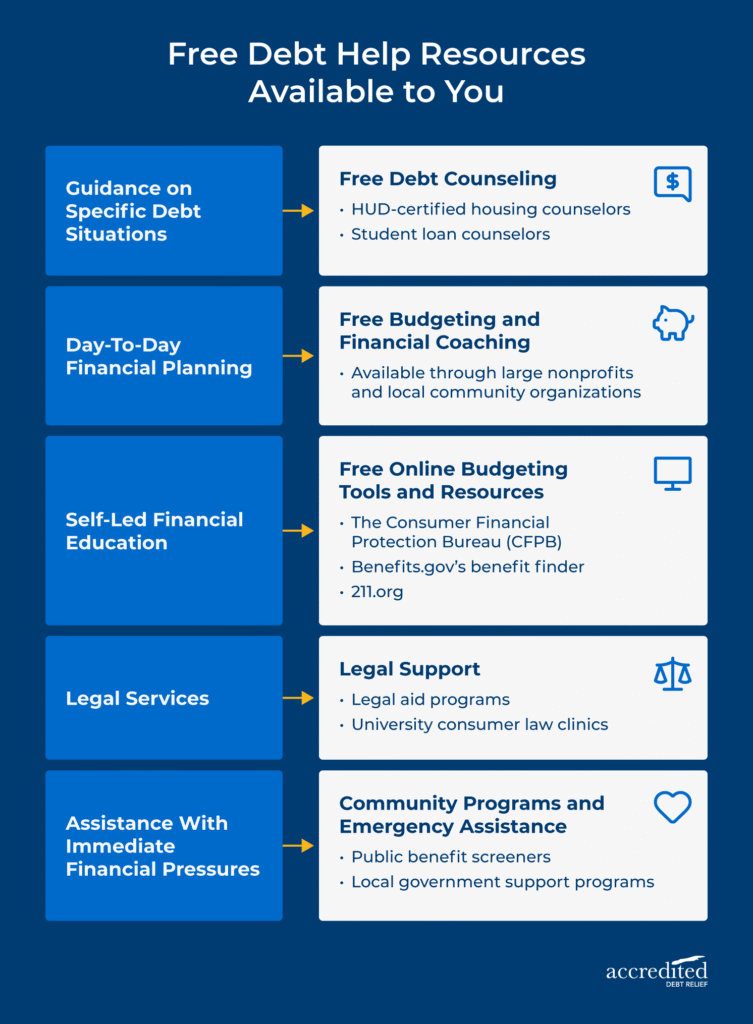
Free Debt Counseling
Debt counseling involves professionals helping you understand your debt and providing actionable advice on how to pay it off. Free debt counseling is available through nonprofit agencies and government-backed programs. Determining which specific type of counseling to get depends on the type of debt you’re carrying and how much you owe.
If you’re not sure where to start, a free debt payoff calculator can also help clarify how much you owe and how long repayments might take. Knowing your total balance, estimated payoff timeline, and approximate total payment can help you figure out which type of support makes the most sense.
HUD-Certified Housing Counselors
If you’re behind on rent or struggling with a mortgage, you can talk to a housing counselor approved by the U.S. Department of Housing and Urban Development (HUD). These counselors can help you understand your housing rights, develop a repayment plan to help you catch up and connect you to programs for renters and homeowners in your community.
Student Loan Counselors
If you’re carrying student loan debt, free counseling is available through several channels. Nonprofit agencies like The Institute of Student Loan Advisors (TISLA) offer guidance on repayment. Some federal loan servicers provide direct support, such as income-driven repayment plans and interest rate reductions (though availability and options vary by servicer).
Student loan counseling can help you build a repayment plan based on your income or enroll in a forgiveness program like Public Service Loan Forgiveness (PSLF). If you qualify, you may be able to reduce or pause minimum payments to help you get back on track.
Free Budgeting and Financial Coaching
The resources above focus on specific debt situations. Financial coaches and budgeting resources help you manage day-to-day spending, set concrete financial goals and build habits that support long-term financial health. People often connect with these coaches and resources through large nonprofits like United Way and local community organizations.
Free Online Budgeting Tools and Resources
If you’d rather start on your own, several free digital tools and government-backed resources can help you take control of your day-to-day finances.
- The Consumer Financial Protection Bureau (CFPB) offers free financial education tools that cover a wide range of topics, including auto loans and mortgages.
- Benefits.gov’s benefit finder helps you identify assistance programs you may be eligible for, including food, health and education.
- 211.org can connect you to various local benefits programs, including state and federal assistance for things like food, housing and disaster recovery support.
Legal Support
Getting a letter in the mail from an attorney is scary, especially when it’s about your debt. Hiring an attorney may feel beyond your abilities and budget, but there are legal services that may be able to help.
Legal Aid Programs
While their services and availability are different from state to state, legal aid programs can be a lifeline for people of more modest means. A legal aid program may be able to assist with wage garnishment, debt lawsuits, evictions and foreclosures and government benefits, like Social Security or disability. These services may have income limits, so be sure to check before reaching out.
Consumer Law Clinics at Universities
Law schools often run clinics where supervised students offer legal help for free. These clinics may be able to assist with disputes with lenders, credit reporting errors and even identity theft issues. Check with nearby, accredited universities to see what options are available in your region.
Community Programs and Emergency Assistance
Debt isn’t always the most urgent financial pressure you’re facing. Various local and national programs exist to help people address immediate financial pressures (like food, housing costs, and utilities) that make it harder to focus on paying off debt. Getting some of that pressure off your plate is a meaningful step forward.
Public Benefit Screeners
These online tools ask simple questions about your household, income, and needs. Based on your answers, they tell you which programs you may qualify for, such as SNAP (food stamps) or Medicaid.
Local Government Support Programs
Cities and counties sometimes offer their own help, such as rent assistance, food pantries, or transportation services. These are often not advertised widely, but your local Department of Human Services website is a good place to look.
A quick way to evaluate services in your area is to dial 211. Operated by the nonprofit United Way, this is a free, national resource that can connect you with housing, nutrition, mental health, and job support.
Community action agencies help low-income families with a wide range of needs, from assistance with paying heating bills to providing Head Start preschool programs.
When Free Help Isn’t Enough
Free debt help is a solid starting point, but if your balances feel unmanageable or you’re struggling to keep up with minimum payments, it may be worth looking into professional help that offers a more structured approach.
Getting debt consolidation help may also be a good idea depending on your situation. Your options include:
- Debt relief programs involve a dedicated team rolling your eligible debts into a single, often lower monthly payment, then working with your creditors to get you debt-free quicker. Accredited Debt Relief specializes in this service and provides free consultations to help you understand how it fits your situation.
- Debt consolidation loans replace multiple debts with a single new loan at a fixed interest rate. This is a good option for people who already have strong credit and a steady income.
- Balance transfer credit cards allow you to move existing credit card balances to a new credit card with a low introductory rate. This option works best if you can pay down the balance before that rate expires and the (often much higher) standard rate kicks in.
FAQ
What’s the difference between free debt help and paid debt relief?
Free debt help typically includes educational resources, counseling and government-backed programs. These tools are designed to help you understand your options and provide guidance, but they won’t directly alter your balances or payments.
Paid debt relief options include structured programs and specialists that work directly with your creditors. Keep in mind that results can vary and not all debts qualify.
Does getting free debt help hurt my credit score?
Accessing a free debt help resource won’t impact your credit score. That said, the actions you take based on what you learn may affect it.
Can I get free help if I have a lot of debt?
Yes. Free debt help resources are available regardless of how much you owe.
Get Professional Debt Help with Accredited Debt Relief
Free debt help resources provide general guidance and point you in the right direction. If you feel you need more support, a debt relief consultation can clarify how a structured program may help your debt situation.
Accredited Debt Relief offers free, no-obligation consultations with Consolidation Specialists. They’ll listen with compassion, answer your questions and provide you with a plan tailored to your specific situation. Over the last 15 years, more than 1.3 million clients have worked with us, and we’ve helped resolve over $15 billion in debt.
Request a free quote to find out what Accredited Debt Relief can do for you.
The information on this site is provided as a general resource and does not constitute legal, tax, or financial advice. While Accredited Debt Relief strives to ensure accuracy, this content, including any third-party sources referenced, should not be the basis for any financial decision. For guidance specific to your situation, we recommend consulting a qualified professional.