
For most families, back-to-school shopping isn’t a short-term, seasonal expense that ends when the school year begins. New data shows most parents are borrowing money to cover school costs year-round, and few are paying it off before taking on new school-related debt.
In a survey of over 1,000 parents of K-12 students, 89% said they feel financial pressure from school costs, and 39% said that pressure peaks before school even starts, during summer shopping. Here’s a look at where that debt comes from and how long it takes to pay down, along with the tradeoffs families make to keep up.
Key Takeaways
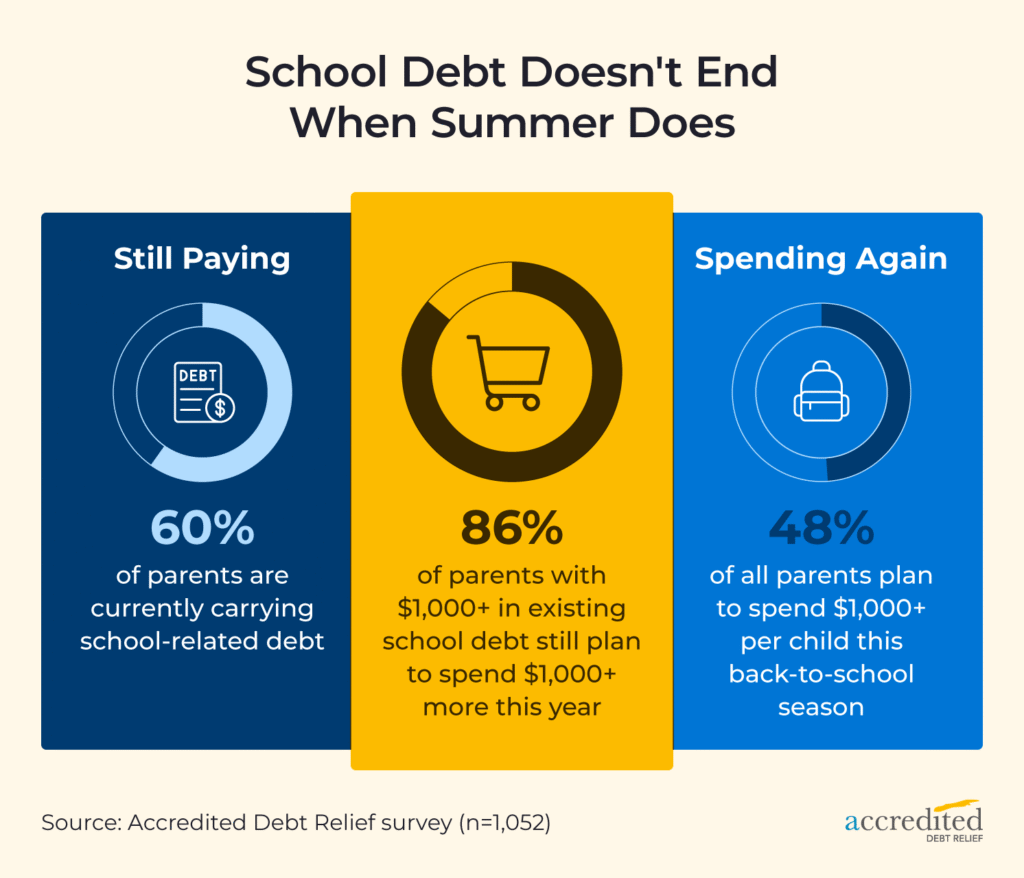
- 60% of parents are currently carrying school-related debt, and 27% already owe $1,000 or more before this fall’s spending begins.
- Among parents carrying $1,000+ in school debt, 86% still plan to spend at least $1,000 per child this fall.
- 53% of parents rely on financing more now than they did three years ago.
- More than half (54%) of parents surveyed are still paying off back-to-school expenses by the time the holiday shopping season begins.
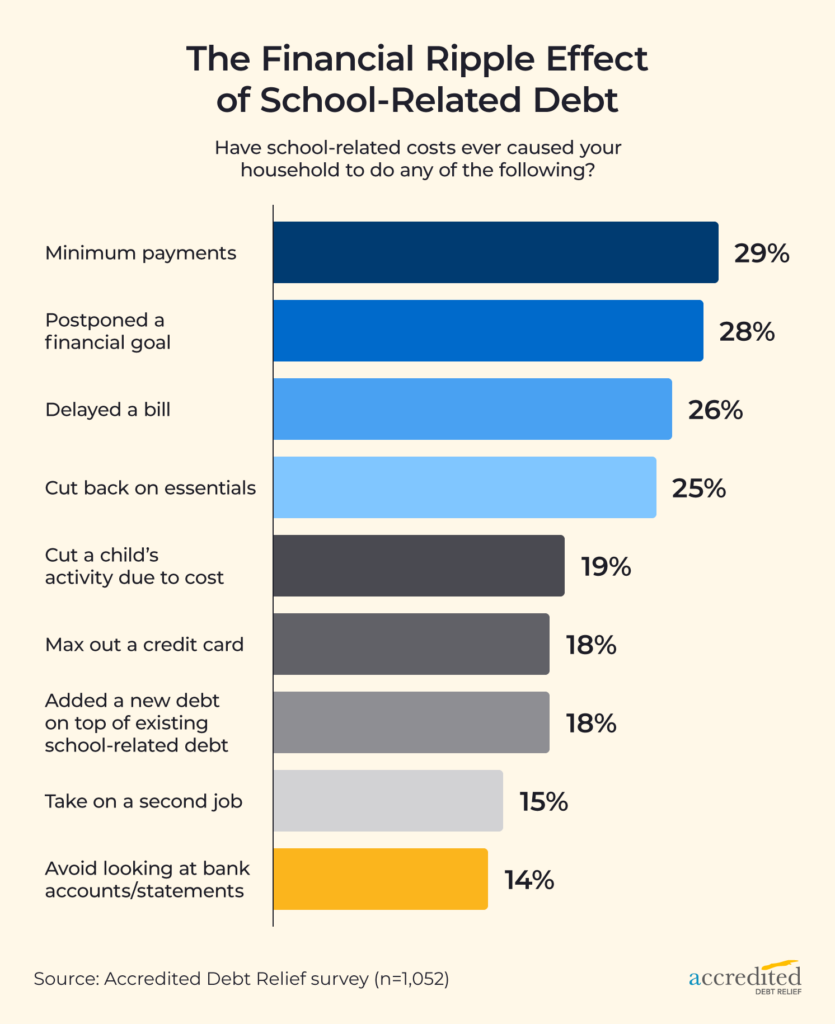
- 76% say school costs triggered at least one financial tradeoff, including only minimum payments, delayed bills or cuts to everyday spending.
- 70% of parents feel confident they can cover school costs this year without going into debt, including 68% of those who already carry $1,000+ in school debt.
More Than 50% of Parents Are Borrowing More for School Now Than They Were Three Years Ago
Parents are seeking financing to cover school costs more often than in past years. 53% of parents say they rely on financing more now than they did three years ago with 26% saying they rely on it significantly more. That intensifies among parents already carrying $1,000 or more in school-related debt, with 75% saying their reliance on financing has grown.
The payment methods tell you where that borrowing lives.
- 32% carry a credit card balance for school expenses
- 22% use BNPL services like Afterpay or Klarna
- 13% turn to a cash advance
A majority (64%) use debit or cash, but plenty of parents use more than one method in the same season, which is part of why the total obligation is hard to see.
This doesn’t just affect parents with lower incomes. Among parents earning $80,000 or more, 60% carry an active school-related debt balance. The numbers back up what parents are feeling. According to the National Retail Federation, back-to-school shoppers were expected to spend $858 on average in 2025, and total K-12 spending is up $600 million since 2024. School just costs more and covers more than it used to.
With more families financing school costs through credit cards, BNPL and loans, how long those balances stick around matters as much as how large they are.
60% of Parents Are Still Paying off School Debt Months After the School Year Begins
Paying off school debt quickly is the exception, with only 23% of parents clearing their school-related charges in the same month. Among those who finance school costs, nearly two-thirds (60%) pay over time, stretching anywhere from one month to more than 12 months, with interest accruing the longer it takes.
The timing is the real problem. More than half of parents (54%) say school debt is still open when the holiday shopping season begins, and 25% say they finance through the holidays most years. The pressure also shows up early: 39% feel it most before school even starts and another 22% feel it most in the first month. For anyone already making minimum payments, that timeline explains why the balance barely moves.
For a lot of families, there’s no clean reset. Last year’s debt hasn’t cleared before summer spending starts and the holidays arrive before the school balance is paid. The seasons end up overlapping into one continuous stretch of spending.
Most Parents in School Debt Plan to Spend $1,000+ More This Fall, and Most Are Confident They Can Cover It
Nearly half (48%) of all parents surveyed plan to spend $1,000 or more per child, and another 28% expect to spend $500–$999. For the 60% already carrying school-related debt, that new spending lands on top of unresolved balances. Among parents who are already carrying $1,000 or more in school debt, 86% still plan to spend at least another $1,000 per child this year.
The spending continues in part because 68% of those same parents with over $1,000 in debt say they’re confident they can cover this year’s costs without going into more debt or falling behind on other bills.
Behavioral economists call it optimism bias. Research from the Federal Reserve Bank of Philadelphia finds that over-optimistic households carry higher debt loads and are less likely to course-correct because they discount forecast errors more readily than their less-optimistic counterparts.
The financial strain from high balances shows up differently depending on income. Clothing and shoes top the list across all income levels, named by 37% of parents as one of their two most burdensome expenses, with electronics next at 25%.
But among parents earning under $40,000, the essentials like supplies, clothing, and transportation dominate the list. At $80,000 or more, 34% still carry $1,000 or more in school-related debt. A bigger paycheck tends to expand what families buy, not reduce what they owe — and the debt accumulates either way.
From Minimum Payments To Skipped Groceries, School Costs Reshape the Whole Budget
When school debt grows, it doesn’t stay contained to a single line in the budget. 76% of parents say school-related costs have led to at least one financial trade-off, reaching well past the school supply aisle.
The most common trade-offs occur in the parts of a budget where families have the least room to maneuver, such as minimum-only payments (29%), postponed savings or debt payoff (28%) and delayed bills (26%). From there, it gets more personal. 25% cut back on everyday essentials like groceries or utilities and 19% kept a child out of an activity because of the cost.
Each of these trade-offs can start to chip away at a family’s financial safety net. Once these become routine, it can be harder to climb out of the cycle of debt as more seasonal expenses pile up. Connecting to free debt help resources can be an easy first step to help families stop this pattern in its tracks.
When School Spending Follows You Past August, It’s Worth Taking A Hard Look at the Full Picture
School costs have grown in both size and scope, and for 60% of parents, that growth has turned into debt that doesn’t resolve before the next round of spending lands. For parents already carrying school debt, things don’t reset when K-12 ends. The financial weight of graduation and what follows just adds to what was already there.
The cycle beneath it works the same way regardless of the school year, repeating whether families notice it or not. Carry a balance, make the minimum payment and add new spending before the old debt clears. That’s how a manageable seasonal expense turns into a year-round obligation a family can’t get out from under. For some households, that might mean looking at whether consolidating those balances makes sense.
If school spending keeps following you beyond the back-to-school season, it’s worth asking whether the problem is the spending or the underlying structure. Accredited Debt Relief helps families understand their options when debt starts to feel like a permanent fixture rather than a temporary stretch.
Methodology
The survey was conducted by Centiment for Accredited Debt Relief. The survey was fielded from May 22-28, 2026. The results are based on 1,052 completed surveys. In order to qualify, respondents were screened to be parents or guardians with at least one child currently enrolled in grades K-12. Data is unweighted, and the margin of error is approximately +/-5% for the overall sample with a 95% confidence level.