
As a healthcare worker, spending long shifts with other people’s lives in your hands is already stressful enough. But if you’re struggling with unsecured debt (like credit card balances, student loans and medical bills), the stress doesn’t go away when your shift ends.
Our Consolidation Specialists at Accredited Debt Relief work with healthcare professionals to consolidate the debt you owe into a manageable monthly payment. They’ll build you a personalized consolidation plan and walk you through every step in plain language.
Healthcare Workers and Credit Card Debt
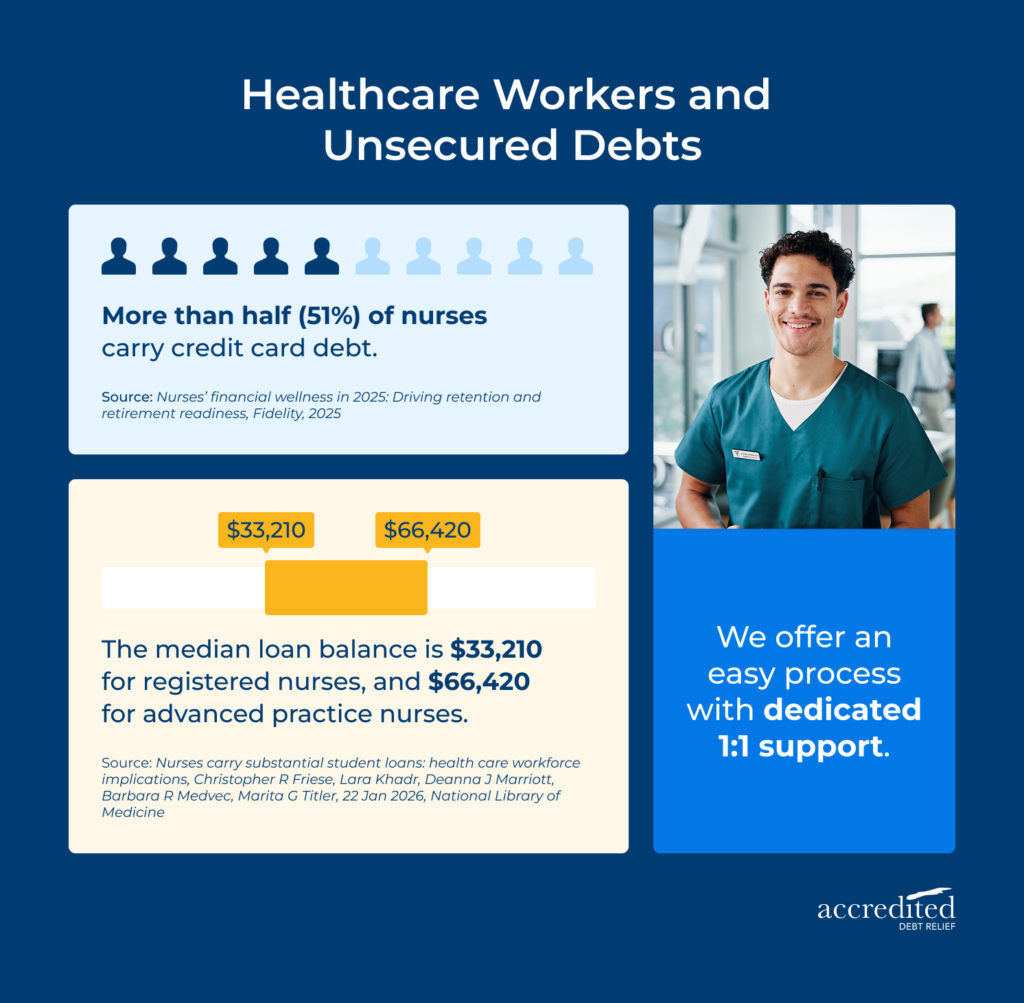
Many nurses, medical assistants, home health aides and other healthcare professionals are forced to juggle multiple debt payments every month. They carry credit card debt to pay for essential services (such as overnight childcare), provide for their family and cope with rising costs of living. Most also manage payments for large student loans, debt they had to take on to qualify for employment.
Healthcare workers often find it difficult to manage such high debt, especially when payments are spread across multiple accounts and providers.
On top of that, many healthcare workers are paid middling-to-low wages, making it even more difficult to keep up with payments. For instance, according to the Bureau of Labor Statistics’ OEWS portal, medical assistants make an annual mean wage of $46,120, while home health and personal care aides make only $36,120. Registered nurses earn a higher annual mean wage of $101,420, but accumulated debt can still make their budgets feel tight month to month.
With so much to deal with, healthcare workers often aren’t aware of the debt help resources available to them. Accredited Debt Relief offers a clear path forward with structured programs that make payments easier to manage.
How Debt Consolidation Works
Debt consolidation involves combining multiple unsecured debts into a single, often lower monthly payment. There are multiple options for consolidating your debt, but Accredited Debt Relief specializes in debt relief programs that simplify and lower your monthly payments.
1. Get Your Free Consultation
We understand that providing debt relief for healthcare workers can’t be done with a one-size-fits-all approach. Our Consolidation Specialists will speak with you for free and take the time to understand your situation before making any recommendations.
2. We Build Your Plan
Your specialist will walk you through the available options and help you choose a personalized debt consolidation plan. Healthcare workers experiencing financial hardship can often lower their eligible monthly payments by 40% or more. This can free up a significant amount of money for essential living expenses like groceries and gas.
3. Get Out of Debt
Once you enroll with Accredited Debt Relief, you’ll have access to a clear payment timeline, an easy-to-use mobile app and a dedicated support team. You’ll typically get out of debt within 24 to 48 months, which is much faster than making minimum payments alone.
Real Stories From Our Clients
Accredited Debt Relief has provided debt relief for nurses, medical assistants, home health and personal care aides and other healthcare workers across the country. One of those people is Jenifer S., a Florida nurse who carried over $43,000 in debt when she reached out for help.
Jenifer’s credit card debt spiraled out of control as she tried to move and set up a new home following a divorce.
“My first phone call felt like a weight was lifted off my shoulders — like there was still hope.”
— Jenifer S. | Accredited Debt Relief Client Story | August 22, 2025
She worked with one of our Consolidation Specialists, who helped her find a personalized payment plan, saving her $440 per month.
Why Healthcare Workers Trust Accredited Debt Relief
Accredited Debt Relief has helped more than 1.3 million people across the U.S. over the last 15 years and resolved over $15 billion in client debt. Our approach to providing debt relief for healthcare workers includes:
- An easy to use mobile app that allows you to track your progress and manage your program on-the-go.
- A dedicated team of specialists who will help you throughout your entire payment plan from start to finish.
- A clear, no-pressure process designed to maximize clarity and eliminate confusion.
- A payment plan designed around your income rather than a generic, one-size-fits-all template.
- No hidden fees, surprise costs or communication gaps — you’ll always have the information and support you need.
- A track record you can verify. Accredited Debt Relief has an A+ rating from the Better Business Bureau and was the recipient of the 2025 Excellence in Customer Service Award.
Take the First Step Today
If you’re a healthcare worker struggling with debt, you’re just one call away from a dedicated specialist who will listen with compassion, answer your questions and provide you with a personalized plan.
Paying off your debt on your terms and with minimal stress is possible. Get a free quote today to find out what Accredited Debt Relief can do for you.
FAQ
Do student loan forgiveness programs cover credit card or personal loan debt?
No. Federal programs offering student loan forgiveness for healthcare workers (and all other professions) apply only to qualifying student loans. Credit card balances and personal loans are considered unsecured debts and require a separate approach, like a debt relief program or consolidation option.
How much student loan debt can healthcare workers get forgiven?
It depends on the program and whether it offers forgiveness or repayment assistance. Public Service Loan Forgiveness cancels your full remaining balance after 120 qualifying payments, while programs like the NHSC and Nurse Corps pay your balance down directly, with amounts that vary by program.
How much unsecured debt do you need to qualify for a debt relief program?
Accredited Debt Relief works with consumers who have at least $5,000 in unsecured debt, one of the lower minimums in the industry. Across the broader market, most debt relief programs require $7,500 to $10,000 to qualify, though minimums vary by company and debt type.
The information on this site is provided as a general resource and does not constitute legal, tax, or financial advice. While Accredited Debt Relief strives to ensure accuracy, this content, including any third-party sources referenced, should not be the basis for any financial decision. For guidance specific to your situation, we recommend consulting a qualified professional.