
- Consolidation can combine medical bills with each other, or with other unsecured debt, to simplify repayment. The right option depends on how much you owe and whether the bill is still with the provider or already in collections.
- There are three common paths to medical debt consolidation. These include enrolling in a debt relief program, taking out a debt consolidation loan and using a balance transfer card.
- Hospitals and providers often offer financial assistance or payment plan options. You can request these directly before exploring debt consolidation.
More than a third of U.S. households carry medical debt, according to research published by the National Institutes of Health. In 2024, 21% had a bill already past due, and 23% were paying a provider over time to keep it from going past due. Managing medical debt can involve requesting financial assistance or a payment plan directly from your provider, or exploring options like consolidation and debt relief.
The right option depends on your financial situation, the size of your balance and whether the debt is still with the original provider or has moved to collections. Here are ways to manage medical debt, including consolidation and other repayment options.
1. Ask About Hospital Financial Assistance
This step is often skipped, but it’s frequently the biggest opportunity for medical debt forgiveness. Under IRC Section 501(r), added by the Affordable Care Act, nonprofit hospitals must maintain a written Financial Assistance Policy and determine whether you qualify for income-based discounts or free care before pursuing collection actions.
To request it, ask the hospital’s billing department for a “financial assistance application” or “charity care application” by name.
2. Check Medical Bills for Errors
Start by comparing your itemized statement against your insurance documents line by line. Duplicate charges, incorrect patient information and wrong billing codes are the most common culprits. Any one of them can inflate what you actually owe.
That inflated number is sometimes what gets carried into medical debt consolidation later, so catching errors early means you’re only consolidating what you actually owe.
3. Appeal an Insurance Denial
Insurers deny claims for reasons that don’t always hold up, from a missing prior authorization to a coding mismatch between what the provider billed and what the plan expected.
Formally challenging that decision in writing and within the insurer’s appeal window can increase the amount the insurer pays. That can reduce the portion of the bill that could otherwise end up in collections or be folded into medical debt consolidation.
4. Verify Your Coverage and Network Status
Call your insurer or check its provider directory before a procedure to confirm that the facility, surgeon and any anesthesiologist or assisting provider are all in-network. One out-of-network provider on an otherwise in-network visit is a common source of surprise bills.
Checking your coverage and network status ahead of time can help you avoid unexpected charges and keep a medical bill from becoming larger than it needs to be.
5. Enroll in a Debt Relief Program
Combine your medical bills with other unsecured debt, such as credit cards or personal loans, into a single plan with one simplified monthly payment.
The goal is more manageable repayment and potentially lower overall costs, though results vary by individual and not all debts qualify. A debt relief program, like the one at Accredited Debt Relief, reviews each client’s full financial picture individually before recommending a plan.
6. Take Out a Personal Loan
Taking out a personal loan pays off medical bills in one lump sum, replacing several statements and multiple due dates with a single fixed payment over time. It’s one of the more common forms of a medical debt consolidation loan for people who want a predictable payment.
Interest rates and fees vary by lender and depend heavily on credit, so this route works best for borrowers who qualify for competitive terms. Review your finances and current payments to make sure a consolidation loan is a good idea for your situation.
7. Apply for a Balance Transfer Card
With a balance transfer card, you move existing balances, including medical bills already charged to a card, onto a new card, often with a lower introductory rate. This form of medical bill debt consolidation can meaningfully reduce interest costs if the balance is paid off before that introductory period ends.
It isn’t the right fit for everyone. Transfer fees and the higher rate that kicks in once the intro period expires can erase the savings for anyone who can’t pay off the balance in time.
8. Negotiate a Payment Plan Directly With the Provider
Many providers will set up a zero-interest or low-interest in-house payment plan if you simply ask. Request interest-free terms and get the agreement in writing before your first payment.
For uninsured or self-pay clients, the No Surprises Act guarantees a Good Faith Estimate before treatment. If the final bill comes in $400 or more above that estimate, you can dispute it through the federal Patient-Provider Dispute Resolution process. The initial bill must be dated within the previous 120 calendar days.
9. Get a Free Consultation With a Consolidation Specialist
If consolidation is the route you’re considering, or you just need someone to walk through your options, a free consultation with a Consolidation Specialist starts with a review of your situation and ends with a plan that fits.
Accredited Debt Relief’s Consolidation Specialists are certified through the International Association of Professional Debt Arbitrators (IAPDA) and lead that first, one-on-one conversation.
Once you’re enrolled, a dedicated Client Success Team takes over, with a client dashboard and app to track progress along the way. Support continues throughout the life of the plan, not just during the initial consultation.
How To Choose the Right Debt Relief Option for You
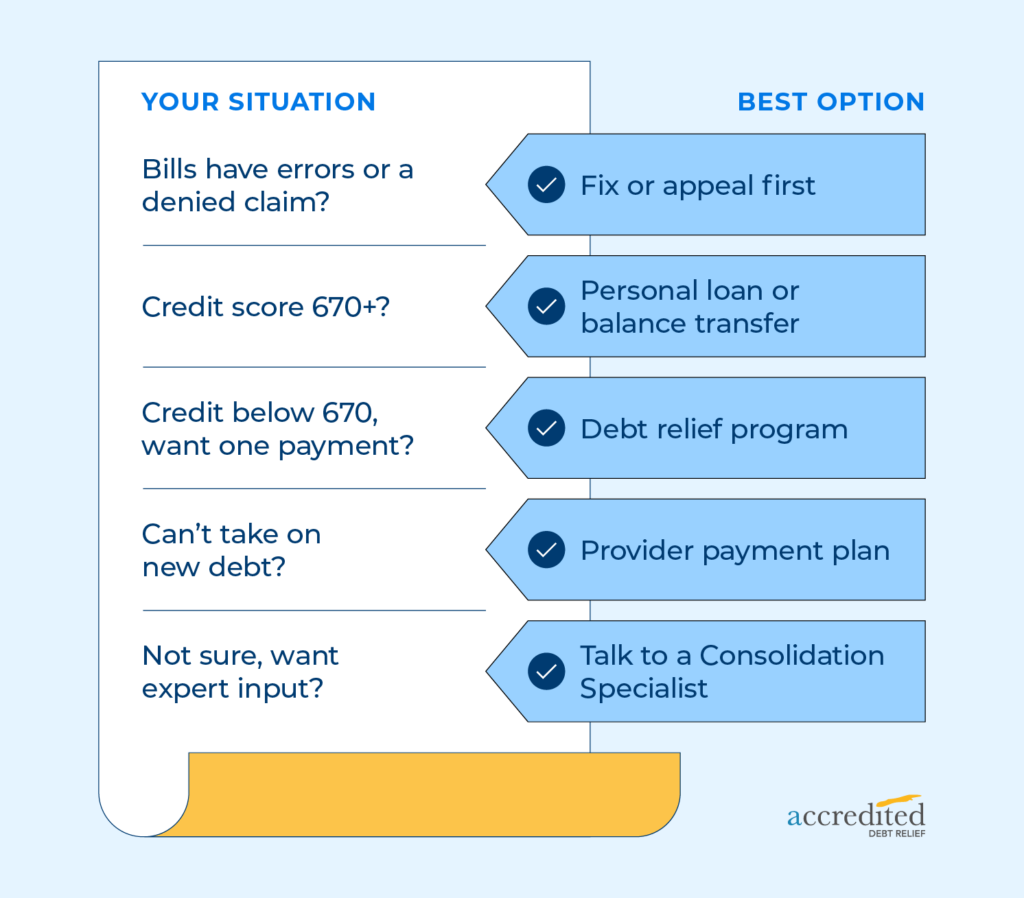
With several approaches on the table, here’s a simple way to narrow it down. Getting started comes down to these five steps:
Step 1: Start by Confirming What You Owe
Before choosing a consolidation route, review your itemized bills for errors and appeal any insurance denials that may affect what you owe. Knowing your final total balance can help you make a more informed decision about how to manage the debt.
Step 2: Check if You Qualify for Free or Reduced Bills
Before taking on new debt or using credit-based options, ask the hospital about available nonprofit financial assistance. You should also research free debt-help resources independently. If you qualify for assistance, reducing the balance first gives you a clearer picture of which consolidation option best fits the remaining debt.
Step 3: Review Your Credit Profile
Pull your credit score for free through your bank, card issuer or annualcreditreport.com and write down where it lands. A score of 670 or higher (FICO’s “good” range and up) generally qualifies for the most competitive rates on a personal loan or balance transfer card.
A lower score, or a preference to skip a hard inquiry altogether, points toward a provider payment plan or a Consolidation Specialist consultation instead, since neither requires a minimum credit score.
Step 4: Talk With a Professional About Medical Debt Consolidation
A free, no-obligation consultation with a Consolidation Specialist puts your debts in front of one person instead of leaving you to compare every option alone. They can help you weigh your options and determine the best path forward for your financial situation.
Step 5: Choose the Approach That Fits Your Needs
Line up what you owe, whether you qualify for reduced bills, your credit standing and any professional recommendations. Then, weigh the pros and cons of each option and choose the one that best fits your financial situation.
Explore Medical Debt Consolidation Options
Medical bills tangled up with credit cards, personal loans or other unsecured debt are a good candidate for a debt relief program, since it brings everything into a single plan.
Accredited Debt Relief can help you review your options and determine whether a debt relief program is right for your financial situation. You can get a clearer picture of your potential path forward before committing to a plan.
Start with a free quote and see exactly what a plan could look like for your situation.
FAQ
What happens if you ignore medical debt?
Ignoring a medical bill doesn’t make it disappear. It typically leads to provider follow-up, a possible referral to a collections agency and, in rare cases, legal action and it can affect your credit report and score. That steady escalation is what happens if you don’t pay medical bills for long enough.
What are the most common medical debt consolidation options?
Common medical debt consolidation options include personal loans, balance transfer credit cards and debt relief programs.
Can you consolidate medical debt along with other unsecured debts?
Yes. Medical bills, including hospital charges, doctors’ bills and other healthcare-related expenses, can typically be consolidated alongside credit cards and personal loans in the same plan.
Does medical debt go away on its own?
Not necessarily. Medical debt doesn’t automatically disappear just because time passes. If you don’t pay it, the debt may eventually become too old to be legally collected, depending on your state’s statute of limitations. However, the debt can still exist after that period, and unpaid medical debt may have other consequences.
How long does medical debt stay on your credit report?
Medical debt can stay on your credit report for up to seven years from the date it first became delinquent. Paid medical debt is generally removed, and medical debt that is less than a year old or has a balance under $500 generally does not appear on consumer credit reports.
Can medical debt be included in a debt relief program?
Yes. Medical bills are typically treated as unsecured debt, which means they can usually be included in a debt relief program alongside other unsecured balances.
The information on this site is provided as a general resource and does not constitute legal, tax, or financial advice. While we strive to ensure accuracy, this content, including any third-party sources referenced, should not be the basis for any financial decision. For guidance specific to your situation, we recommend consulting a qualified professional.